
Digital marketing has fundamentally reshaped what was once considered the backbone of business growth — yet a closer examination reveals that this assumption deserves serious scrutiny. For decades, before digital marketing emerged as a dominant force, businesses poured enormous resources into traditional marketing channels — television commercials, print advertisements, billboards, and radio spots — operating under the belief that visibility alone was enough to drive consumer behavior. However, as the digital marketing revolution fundamentally dismantled the old rules of communication and commerce, it became increasingly clear that simply reaching customers was no longer sufficient. Strategies rooted in digital marketing exposed a glaring gap between broadcasting a message and genuinely engaging an audience — a distinction that traditional channels had long ignored.
The rise of digital marketing did not happen in isolation; it was fueled by shifting consumer expectations, the explosive growth of the internet, and the democratization of information. Businesses that once relied solely on expensive, one-directional advertising campaigns were forced to rethink their entire approach as digital marketing introduced measurable, targeted, and interactive alternatives. Today, digital marketing has not merely transformed how brands connect with their audiences — it has completely redefined what a “connection” even means in a commercial context, elevating it from a simple transactional exchange to an ongoing, data-informed, and deeply personalized relationship between brand and consumer.
Unlike traditional marketing, which largely treated consumers as passive recipients of carefully crafted brand messages, digital marketing has handed power directly to the consumer. Social media platforms, search engines, influencer ecosystems, and data-driven personalization have created an environment where audiences now dictate the terms of engagement. Brands are no longer the loudest voice in the room — they are guests in a conversation they do not fully control.
More provocatively, some marketing theorists now argue that traditional marketing is not merely “less effective” in the digital age — it is actively counterproductive, breeding skepticism and indifference among increasingly ad-fatigued consumers. The future of marketing, therefore, may not be about reaching more people, but about reaching fewer people more meaningfully — prioritizing depth of relationship over breadth of exposure. In this new reality, the brands that will thrive are not necessarily those with the biggest budgets, but those with the most authentic stories and the courage to let their audiences help tell them.
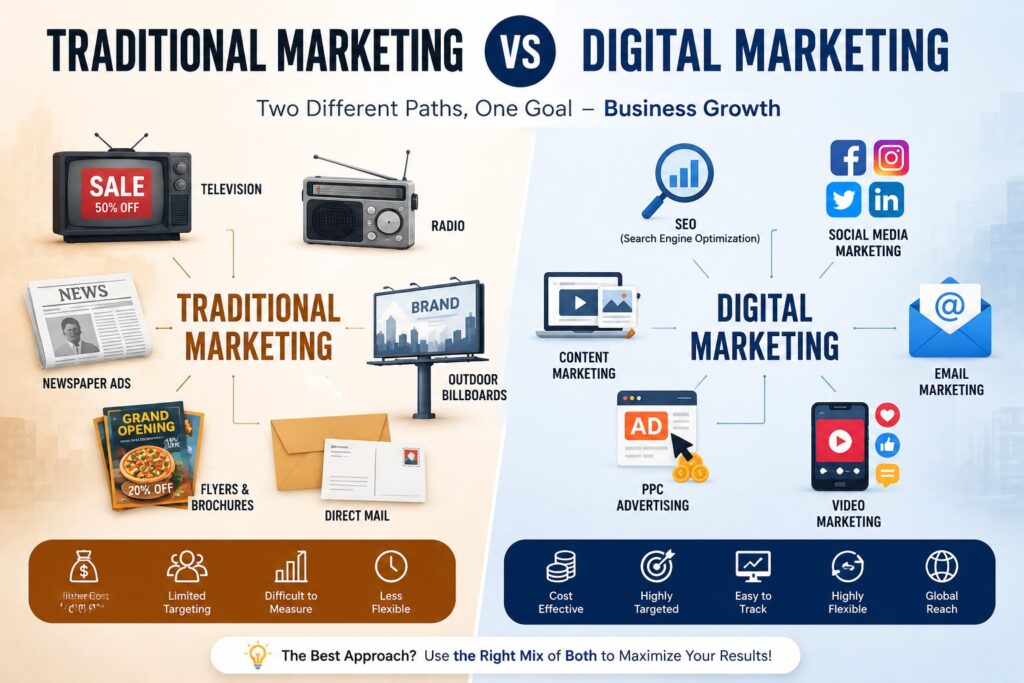
Understanding the differences between traditional and digital marketing can help businesses choose the right strategy for their goals.
What Is Traditional Marketing?
Traditional marketing refers to promotional methods that have been used for decades through offline channels.
Examples include:
* Television commercials
* Radio advertisements
* Newspaper ads
* Magazine advertisements
* Billboards
* Flyers and brochures
* Direct mail
Traditional marketing aims to reach a broad audience through mass communication channels.
Advantages of Traditional Marketing
* Reaches audiences who are less active online
* Builds strong local brand awareness
* Tangible materials can leave a lasting impression
* Often perceived as more credible by older demographics
Limitations of Traditional Marketing
* Higher advertising costs
* Difficult to measure campaign performance accurately
* Limited audience targeting
* Less flexibility once campaigns are launched
What Is Digital Marketing?
Digital marketing involves promoting products or services through online channels and digital technologies.
Examples include:
* Search Engine Optimization (SEO)
* Social Media Marketing
* Content Marketing
* Email Marketing
* Pay-Per-Click (PPC) Advertising
* Influencer Marketing
* Video Marketing
Digital marketing enables businesses to connect with highly targeted audiences across multiple platforms.
Advantages of Digital Marketing
* Cost-effective compared to traditional advertising
* Precise audience targeting
* Real-time performance tracking
* Global reach
* Higher engagement and interaction
* Easy campaign optimization
Limitations of Digital Marketing
* Requires continuous content creation
* Highly competitive environment
* Algorithm changes can affect visibility
* Results may take time depending on the strategy
Which Marketing Strategy Is Better?
The answer depends on your business objectives, target audience, and budget.
Traditional marketing may be effective if:
* Your target audience includes older demographics.
* You want strong local visibility.
* Your business relies on offline customer interactions.
Digital marketing may be the better choice if:
* You want measurable results.
* You have a limited budget.
* You need precise audience targeting.
* You want to build an online presence and generate leads.
The Best Approach: Integrating Both
Rather than choosing one over the other, many successful brands combine traditional and digital marketing to maximize results.
For example:
* A billboard can promote a website or social media page.
* A television ad can encourage viewers to scan a QR code.
* Print materials can direct customers to online content.
This integrated approach helps businesses create a seamless customer journey across both offline and online channels.
Conclusion
Traditional marketing and digital marketing each have unique strengths. Traditional marketing excels at broad awareness and local reach, while digital marketing offers precise targeting, measurable performance, and cost efficiency.
In today’s business environment, the most effective strategy is often a balanced combination of both. By leveraging the strengths of each approach, businesses can reach more customers, build stronger relationships, and achieve sustainable growth